

The Book of Fairness
ABOUT THE BOOK
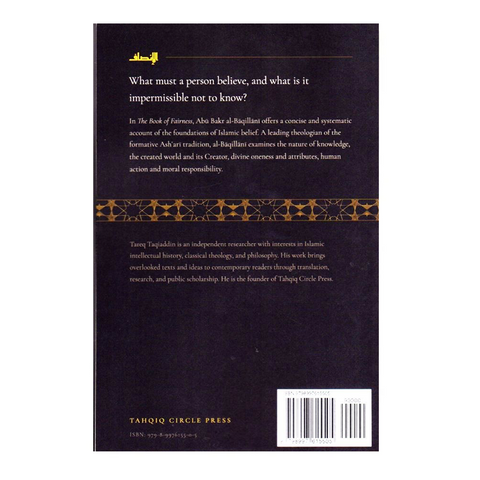
Al-Bāqillānī begins by asking how we know anything at all, then uses that foundation to work through some of the largest questions a theologian can face: Why does the world require a Creator? What can we truly say about God? How should we understand divine attributes without imagining God as a body, image, or being confined by place?
From there, the book moves into the disputes that shaped classical Islamic theology. Al-Bāqillānī considers the nature of the Qurʾān and divine speech, the relationship between God’s power and human responsibility, the meaning of faith, the proof of prophecy, the purpose of miracles, the legitimacy of the imamate, intercession, and the vision of God in the hereafter.
What makes the book so compelling is its directness. Al-Bāqillānī does not simply hand the reader a list of doctrines. He shows how the pieces fit together, why particular distinctions matter, and what happens when an argument is followed to its conclusion. At times compressed, at times unexpectedly vivid, the text offers the experience of encountering a major medieval theologian at work.
For anyone curious about how Muslim thinkers reasoned about God, revelation, freedom, and certainty, The Book of Fairness is an unusually rich place to begin.
The Arabic text behind this translation
Translated from al-Bāqillānī’s al-Inṣāf fīmā yajibu iʿtiqāduhu wa-lā yajūzu al-jahlu bihi, introduced and annotated by Muḥammad Zāhid al-Kawtharī, Cairo: Maktab Nashr al-Thaqāfa al-Islāmiyya, 1369/1950. The source copy is held by Columbia University Libraries (BP160 .B3 1950) and digitized by Arabic Collections Online.
Difficult readings were checked against the scan, with a later Beirut reprint consulted where relevant. Consequential defects and uncertainties are documented rather than silently smoothed over. Square brackets mark minimal translator supplies; angle brackets identify supplies by al-Kawtharī. His editorial voice remains distinct from al-Bāqillānī’s text.
This is a translation of the 1950 printed edition. The manuscript mentioned on its title page was not examined for this translation. The full edition’s Note on the Translation and Textual and Evidentiary Note explain the method and its limits.
