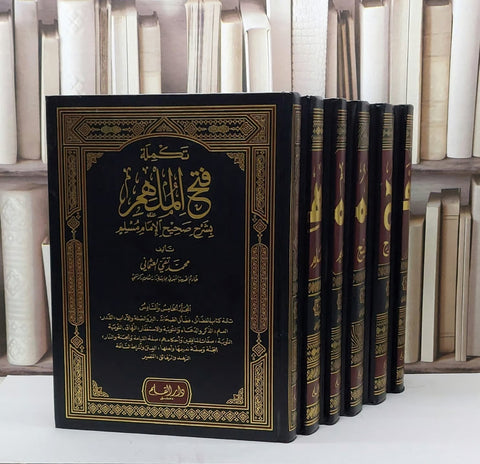
Allamah Zahid al-Kawthari [رحمه الله]’s praise of Fath al-Mulhim fi Sharh Sahih Muslim is recorded in his Maqalat. Fath al-Mulhim is the masterpiece commentary of the Sahih of Imam Muslim [رحمه الله] by Maulana Shabbir Ahmad Uthmani [رحمه الله].
The people of knowledge have a special interest in Sahih Muslim, in recognition from them of its lofty position amongst the six mother-books of Islam. Some of them composed mustakhrajat [a collection of the same hadiths with different chains] upon it; and some of them compiled specifically on its narrators; and some of them paid interest to the areas criticised by some critics of the chain and text; and some of them strove to clarify its hidden meanings and comment on the manners of its indications and release all that was locked in its chains.
From the group of the commentators of this eminent book are:
- Imam Abu Abd Allah Muhammad ibn Ali al-Mazini [رحمه الله] author of al-Mulim fi Sharh Sahih Muslim;
- and from them is al-Qadi Iyad ibn Musa al-Yahsabi [رحمه الله] author of Ikmal al-Mulim fi Sharh Sahih Muslim;
- and from them is Abu al-Abbas Ahmad ibn Umar al-Qurtubi [رحمه الله] author of al-Mufhim lima Ashkala min Talkhis Kitab Muslim;
- and from them is Abu Zakariyya Muhyi al-Din Yahya al-Nawawi [رحمه الله] author of al-Minhaj fi Sharh Sahih Muslim ibn al-Hajjaj which is derived [primarily] from the three books of these luminaries that we mentioned and Maalim al-Sunan of al-Khattabi.
This commentary of al-Nawawi is the first commentary to appear in the world of printing from the commentaries of Sahih Muslim, although it is not of that which quenches the thirst of the researcher in all objectives. Then there appeared Ikmal Ikmal al-Mulim by Abu Abd Allah Muhammad ibn Khalifah al-Ubbi [رحمه الله] in the world of existence which was printed around thirty years ago together with Mukmil Ikmal al-Ikmal by Abu Abd Allah Muhammad ibn Muhammad al-Sanusi [رحمه الله], in which they collected the essence of what is found in the previous commentaries, of benefits, together with their amendments as far as was possible for them, and the people of knowledge were greatly impressed with them due to what they received in them of a degree of expansion in comparison to the commentary of al-Nawawi printed previously.
However, truth be told, none of these commentaries fulfil the right of Sahih Muslim, of commentary and exposition from all perspectives, which concern the thirsty researchers [seeking] to reveal the secrets of the book. So if one commentary excels in jurisprudence or beliefs according to one school, for example, you find it lacking in the commentary of what relates to the remainder of the schools of practice and belief. This does not quench the thirst of the researcher. Or you find it neglecting the commentary of its introduction despite it being from the oldest of what the imams of hadith wrote in preparing the principles of the science of hadith like the book al-Tamyiz by Muslim, and such [a book] deserves a full commentary. And you find amongst the commentators those who omit commenting on the narrators altogether, although the researcher is in great need of this in areas of known criticism. Hence, when one of these commentaries pleases you from some perspectives, you find it does not quench your thirst from other perspectives. The remainder of the commentaries are similar. This is a substantial gap. We had the strongest desire that a commentary of Sahih Muslim appears in the world of print to fill this gap.
Now we are ones who have chanced upon our longed-for lost treasure in the production of Fath al-Mulhim fi Sharh Sahih Muslim in its wonderful dress and brilliant suit in a number of Indian prints. Till now two large volumes of it have been printed. The number of pages in each of its volumes is five hundred, and the number of lines in every page is 35. If the book were printed in Egypt, each volume would be two volumes in large size paper. The entire book is like this in five volumes, and the third volume is about to be published.
We were very pleased by this glorious and splendid commentary, in form and meaning, since we found it adequate and satisfactory from every perspective. And it filled, in the true sense, that void which we alluded to. Hence, the researcher finds a big introduction at its opening, collecting miscellanea of the science of the principles of hadith with brilliant research, collecting the opinions of the hadith-scholars who have written on this topic, according to what the scholars of the principles of jurisprudence authorised in accordance with the different schools, not being limited to one party besides another. Thus, this marvellous introduction suffices the researcher the burden of looking at endless sources. After the amazing introduction is a hundred pages giving the researcher a commentary of the introduction of Sahih Muslim, a commentary by which the breast of the examiner will expand, since the brilliant commentator did not leave any place of ambiguity therein at all, rather he explained what is for it and what is against it with absolute fairness. Then he commented on the hadiths in all the chapters with the utmost balance, so he left no juristic issue without his full assessment, rather he enumerated the proofs of the schools in the juristic issues and compared them, strengthening the strong and weakening the weak with utmost fairness.
Likewise, this learned commentator did not neglect any hadith-related matter in all of the chapters, rather he gave it its full due, of verification and elucidation. Hence, he exhausted:
- determining the correct vowelling of the names;
- explanation of the uncommon words;
- discussion of the narrators;
- verification of the areas in which some imams of this field brought various objections from the perspective of the art, not yielding to the acceptance of the statement of those who said, All who the two shaykhs have transmitted from, he has jumped the hurdle, as a means to blind imitation.
He refuted many deviant groups in this commentary of his and he had complete impartiality in his refutations of the opponents from the jurists and hadith-scholars. And he produced while commenting on hadiths many runaway benefits and lofty realities which none realise besides exceptional men and masters of the hearts.
There is no surprise that this commentary is as we described, rather better than what we described to the fair reader, since its author is that brilliant scholar, the proof, the embodiment of multiple sciences, the verifier of this age, the exegete, hadith-scholar, expert jurist, deep critic, Maulana Shabbir Ahmad al-Uthmani, teacher of hadith at the Islamic University in Dabhel, Surat, in India, and principal of Dar al-Ulum Deoband, the Azhar of the Indian lands, and author of famous works on the sciences of the Quran, hadith, jurisprudence and refutation of opponents. May Allah extend his stay in affluence and good health, and enable him to complete the publication of this priceless commentary, and to compile many such [works] in which is happiness in the two abodes; and may He benefit by his sciences the Muslims in the east and west of the earth. Verily, He is Near, Responding.
(Maqalat al-Kawthari, pp. 74-5)
Source: ‘Abd Allāh | June 14, 2013
https://friendsofdeoband.wordpress.com/2011/11/23/allamah-zahid-al-kawtharis-praise-of-fath-al-mulhim/
Picture credit: https://daratlas.sa/products