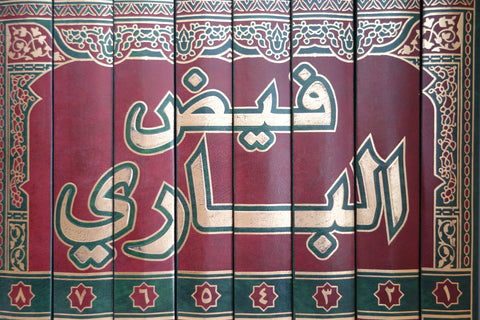
Fayd aI-Bari ‘ala Sahih al-Bukhari is a commentary on al-Jami’ al-Sahih of Imam al-Bukhari in the Arabic language and was compiled from the dictations and lecture notes of ‘Allamah Anwar Shah Kashmiri (hereinafter referred to as Shah Sahib) by one of his students, namely, Mawlana Badr ‘Alam Mirathi.
Mawlana Badr ‘Alam Mirathi was born in Bidayu in 1898 in South India. In 1947 he migrated to Pakistan and a few years later he migrated to Madinah, Saudi Arabia, where he passed away in 1965.
At the age of 14, Mawlana Badr ‘Alam Mirathi was admitted as a student at Mazahir al-‘Ulum in Saharanpur, U.P., India. He qualified as an ‘alim in 1918 and taught in Saharanpur for two years. In 1920, he enrolled at Dar al-‘Ulum Deoband in order to specialize in hadith. He spent four years at that institution as a student of Shah Sahib. In 1927 when Shah Sahib moved from Deoband to Dhabel, Mawlana Badr ‘Alam Mirathi also moved to Dhabel where he spent five years teaching. While he was engaged in teaching, he enrolled as a student of Shah Sahib. It was during that period that he undertook to write down the dictations of Shah Sahib’s commentary on al-Jami’ al-Sahih of Imam al-Bukhari. Mawlana Badr ‘Alam Mirathi requested Shah Sahib to revise the dictations which were in manuscript form. The manuscript was titled Fayd aI-Bari ‘ala Sahih al-Bukhari and was later published by Matba’ah al-Hijazi in Cairo under the auspices of Majlis ‘Ilmi in Arabic. Its publication was financed by Jam’iyat ‘Ulama Transvaal of South Africa.
Special Features of Fayd aI-Bari ‘ala Sahih al-Bukhari
Fayd aI-Bari consists of four lengthy volume. Its special features are discussed hereunder:
- Its first volume consists of a lengthy introduction, which deals with the biography of Shah Sahib and notes on al-isnad (chain of narrators) by Mawlana Muhammad Yusuf Binnuri. It also includes a biography of Imam al-Bukhari and the special characteristics of Imam al-Bukhari’s hadith compilation and other related issues. For example, the total number of hadith recorded in it, and under what conditions it was compiled, etc are discussed.
- This work gives extensive coverage to Tarjumat al-Abwab (explanation of the chapter headings) in order to acquaint the reader with the relationship that exists between the headings of the chapters and the hadith contained in them.
- The subject of ‘aqa’id (beliefs) is also discussed in great detail so as to impress upon the reader the need for one to have the correct belief as a Muslim.
- The ruwat (narrators) are identified so that the reader may have an idea as to who they actually were. For example, the chain of narrators that appear in the very beginning of al-Jami’ al-Sahih of Imam al-Bukhari are recorded thus:
“AI-Humaydi ‘Abd Allah Ibn al-Zubayr reported on the authority of Sufyan who reported on the authority of Yahya Ibn Sa’id al-Ansari who reported on the authority of Muhammad ibn Ihrahim al-Taymi who said that he heard ‘Alqamah bin Waqqas al-Laythi say that he heard ‘Umar Ibn al-Khattab (Allah be pleased with him) say from the pulpit…” In Fayd aI-Bari, al-Humaydi is identified as the teacher of Imam al-Bukhari whose name was in fact ‘Abd Allah Ibn al-Zubayr who died in 219 Hijri. Sufyan is said to be the famous muhaddith (hadith scholar) Sufyan Ibn Uyaynah who was the student of Imam Ahmad Ibn Hanbal. Yahya Ibn Sa’id al-Ansari is identified as the son al-Qays who died in 198 Hijri and was the teacher of both Imams Abu Hanifah and Awza’i.
- Certain omissions of Imam al-Bukhari are also highlighted. For example, it is pointed out that Imam al-Bukhari should have included under the chapter titled as باب السِّوَاكِ all the ahadith that pertain to siwak (brushing of the teeth with a tooth-brush in the form of a pencil from the root of a special type of tree known as the Arak tree). Imam al-Bukhari, on the other hand, chose to include the ahadith on siwak at two different places, namely in كتاب الوضوء (The Book of Ablution) and كتاب الجمعة (The Book of Friday).
- An effort has also been made to extrapolate a fiqhi (legal) ruling, wherever possible, from some of the subjects that have been tackled in al-Jami’ al-Sahih of Imam al-Bukhari. For example, under كتاب الوضوء (The Book on Ablution), there is a chapter which is entitled: باب التَّسْمِيَةِ عَلَى كُلِّ حَالٍ (Chapter: To Recite “In the Name of Allah” During Every Action…) Commenting on whether it is compulsory to mention the tasmiyyah (the Name of Allah) at the time of performing the ablution, it is mentioned that Shah Sahib was of the view that it is not wajib (compulsory) to do so and that his view was in conformity with all the Imams of the Schools of Islamic Jurisprudence except Imam Ahmad ibn Hanbal. Likewise, Shah Sahib went further to explain that amongst the Hanafi scholars, only Ibn Humman, the author of Fath al-Qadir, was of the view that the tasmiyyah is a compulsory component for the ablution to become valid. Shah Sahib was inclined to believe that Imam al-Bukhari also held that view.
Shortcomings in Fayd aI-Bari ‘ala Sahih al-Bukhari
The writer of this dissertation [Mawlana Dr. Yunus Usman] is of the view that while Fayd aI-Bari is an excellent commentary on the hadith compilation of Imam al-Bukhari, some of its shortcomings may be enumerated as follows:
- It is in the Arabic language and this makes it inaccessible to the vast majority of lay Muslims. In other words, only Muslim scholars and others who have mastered the Arabic language may derive any benefit from it.
- The original text of al-Jami’ al-Sahih of Imam al-Bukhari has not been included in Fayd aI-Bari and hence for the reader to be in a position to make sense of the commentary, he/she would have to have a copy of the hadith compilation of Imam al-Bukhari at hand. This makes it cumbersome for the reader to refer to both works simultaneously.
- The author of Fayd aI-Bari has not included, in some instances, the full title of the chapters and this may result in the reader not being able to grasp the full import of the commentary. For example, on page 79 the title of the chapter is mentioned as: باب الْمُسْلِمُ instead of: باب الْمُسْلِمُ مَنْ سَلِمَ الْمُسْلِمُونَ مِنْ لِسَانِهِ وَيَدِهِ
Source: ‘Abd Allāh | November 23, 2011
https://friendsofdeoband.wordpress.com/2013/06/14/an-introduction-to-fayd-ai-bari-ala-sahih-al-bukhari/
Picture credit: https://arabicbookslondon.com/books/fayd-al-bari-sharh-sahih-al-bukhari-8-vols