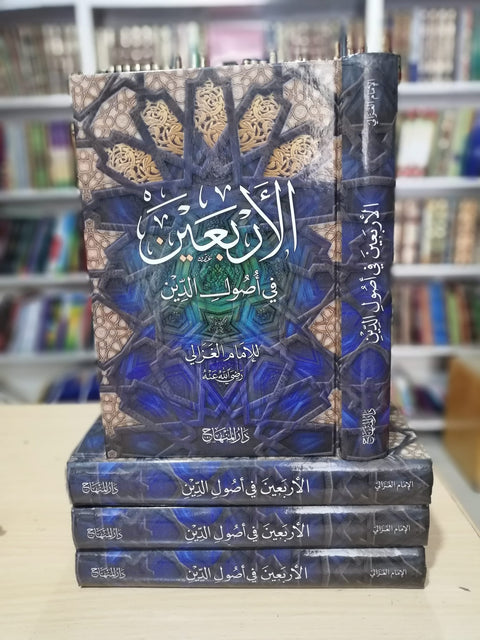
[KITĀB] AL-ARBA῾ĪN FĪ UṢŪL AL-DĪN
كتاب الأربعين في أصول الدين
ط. دار االمنهاج 1439\ 2017
تأليف: حجّة الإسلام الإمام أبي حامد محمد بن محمد بن محمد بن أحمد الغزالي الطوسي الطبراني الشافعي (450 -505)
Imam Abu Ḥamid Al-Ghazali needs no introduction to any Muslim. Popularly known by the title of 'Ḥujjat al-Islām' (the proof of Islām), Imām al-Ghazāli is one of the most phenomenal scholars and ṣūfi masters in the history of Islām who, till this day, continue to amaze humanity with the depth of their knowledge, wisdom and spiritual light that emanate from their works. Author of tens of major works – mostly in Arabic, and some in his native Persian – Imām al-Ghazāli's magnum opus is without doubt his monumental Iḥyā̕ ῾Ulūm al-Dῑn (Revival of the Sciences of the Religion). [Kitāb] Al-Arba῾ῑn fi Uṣūl al-Dῑn (Forty Chapters on the Foundations of the Religion) could arguably be described as a miniature version of his Iḥyā̕ – although, the Iḥyā̕ is what it is - it is huge and a very detailed and breath-taking work on the spiritual and inner dimensions of Islām. This current publication is a new and properly researched (muḥaqqaq) deluxe edition of the [Kitāb] Al-Arba῾ῑn fi Uṣūl al-Dῑn by one of the more reputable publishers of the Middle East – Dār al-Minhāj (Riyadh/Jeddah). Measuring 222 x 152 mm, the book is compact. It comprises 543 cream-coloured pages and the text is in two colours – black and maroon. The paper is high quality and the text has been thoroughly researched and compared with several manuscripts of the book, with hadith references and other useful annotations added by the editors throughout the edition – all common features of Dār al-Minhāj's publications, as we have repeatedly seen over the last several years.
Obviously and without doubt, the Iḥyā̕ is and shall always remain an unparalleled wonder of wonders, and it shall continue to astound academia of the East, as well as the West. The Iraqi-Indian master, Imām Sayyid Muḥammad Murtaḍā al-Zabῑdi's (1145-1205/1732-1791) massive commentary on the Iḥyā̕, titled Itḥāf al-Sādat al-Muttaqῑn bi Sharḥi Iḥyā̕ ῾Ulūm al-Dῑn, has added another layer of astoundment to an already astounding masterpiece.1 For a much quicker read and a comparatively very brief summary of many (but not all) topics covered in the Iḥyā̕, Imām al-Ghazāli's [Kitāb] Al-Arba῾ῑn is highly recommended. Indeed, the book was so much liked by the Al-Ghazāli of India, Imām Mawlānā Muḥammad Ashraf ῾Ali Thānwi, that he desired the book be rendered to Urdu to aid the Muslims of the Indian subcontinent in their character and spiritual reformation. When this was accomplished by Shaykh Muḥammad ῾Āshiq-e-Ilāhi, Imām Thānwi was impressed and delighted, and he expressed this in his foreword to the Urdu translation.2
[Kitāb] Al-Arba῾ῑn fi Uṣūl al-Dῑn is actually not a book that Imām al-Ghazāli authored separately. It is in fact the third of three parts of his book Jawāhir al-Qur̕ān. When writing this third part of Jawāhir al-Qur̕ān, he had indicated that, should someone wish in the future to separate this third part of the book and publish it separately, that will be possible, and, should this happen, he (Imām al-Ghazāli) himself titled this separate book [Kitāb] Al-Arba῾ῑn fi Uṣūl al-Dῑn.3
In his introduction, Imām al-Ghazāli states that [Kitāb] Al-Arba῾ῑn fi Uṣūl al-Dῑn is composed of the following:
῾Ulūm (Categories of knowledge)
A῾māl (Categories of actions)
A῾māl (actions) are then categorised into ẓāhirah (outer/visible) and bāṭinah (inner/invisible).
The bāṭinah (inner/invisible actions) are then further categorised into tazkiyah (cleansing/ridding) and taḥliyah (adorning or inculcating/adopting).
Thus, there are four categories:
῾Ulūm (Categories of knowledge)
A῾māl ẓāhirah (Categories of outer/visible actions)
Akhlāq madhmūmah, tajibu 'l-tazkiyatu minha (Blameworthy traits, cleansing oneself from which is obligatory)
Akhlāq maḥmūdah, tajibu 'l-taḥliyatu biha (Praiseworthy traits, adorning oneself with which is obligatory)
Every category (out of the four) is then divided into ten foundations (or roots).4
Thus, the book is in forty short chapters, from which it takes its title of [Kitāb] Al-Arba῾ῑn fi Uṣūl al-Dῑn (Forty Chapters on the Foundations of the Religion).
Abu Asim Badrul Islam
Northampton
ENGLAND
20 Jumādā al-Ākhirah 1440/26 February 2019