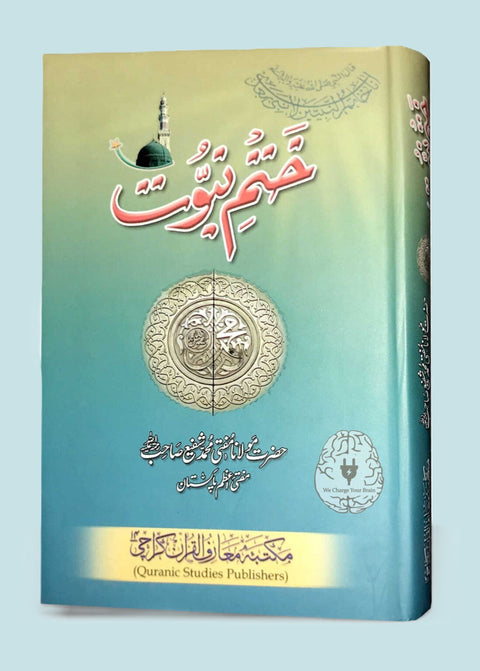
ختم النبوة
باللغة الأردية مع مستدلات عربية
للإمام العلامة الشيخ محمد شفيع - رحمه الله تعالى ) ت 1396 \ 1976 )
Authored by one of the greatest masters of the Islamic sciences of the last century, and a magnificent spiritual master, Imām Mufti Muḥammad Shafῑ῾ (father of our masters, ῾Allāmah Mufti Muḥammad Taqi Usmani and Shaykh Mufti Muḥammad Rafῑ῾ Usmani), Khatm-e-Nubuwwat (The Finality of Prophethood) is a unique masterpiece. Comprising 406 pages, the 1419 (1998) edition that I have is the final and complete edition of this amazing and detailed enquiry into the concept of the finality of the prophethood of the Messenger of Allāh, Muḥammad (may the eternal peace and blessings of Allāh be upon him). The book was completed by the author over a number of years and in three separate parts, which are preceded by two prefaces and an introduction – all by the author. The first preface is the later of the two – it is the preface to the fourth edition of the book and is dated by the author as 5th Jumada 'l-Ūlā 1385 AH/1st September 1965 CE. This is followed by the preface to the first edition of the book, which is longer, but has no date. This is then followed by a 19-page introduction, wherein the author further discusses the background to the book, having already discussed some of it briefly in the prefaces. The book is then divided into three parts. They are:
Part One: Khatm al-Nubuwwah in the Qur̕ān (ختم النبوة في القرآن )
Part Two: Khatm al-Nubuwwah in the Ḥadῑth (ختم النبوة في الحديث )
Part Three: Khatm al-Nubuwwah in Āthār (traditions of the Noble Companions of the Messenger of Allāh, their successors and their successors - ختم النبوة في الآثار ) In the preface to the fourth edition, the author mentions that his first writing on the topic of finality of the prophethood of the Messenger of Allāh, Muḥammad (may the eternal peace and blessings of Allāh be upon him) was a treatise entitled Hadiyyat al-Mahdiyyῑn fi Āyāti Khātam al-Nabiyyῑn, which he wrote in Arabic, upon the instruction of his teacher, Ḥujjat al-Islām Mawlānā Muḥammad Anwar Shāh Kashmῑri, so that it could be distributed in Iraq, Egypt and other Arabic-speaking countries, where the Qadiyani fitnah was spreading to. This was published in 1342 AH/1924 CE from the Dār al-῾Ulūm in Deoband, India (where both were senior professors at the time). In 1343 AH/1925 CE, the author was requested by his teacher, Shaykh al-Islām Mawlānā Shabbir Aḥmad ῾Uthmāni and Mawlānā Sayyid Murtaḍā Ḥasan to write a more detailed book on this topic in Urdu. This work became Khatm-e-Nubuwwat (The Finality of Prophethood) and was first published in 1343 AH/1925 CE from Maktabah Dār al-Ishā῾at (Deoband, India).
The background to the book, and that which instigated the work, was the emergence of Ghulam Ahmad Qadiyani of Qadiyan, in the Punjab region of the then British India. Ghulam Qadiyani (also referred to as 'Mirza', and his followers 'Mirza'is' or 'Qadiyanis') started his public life as a common mulla or cleric. He then, gradually over a few phases, declared prophethood. However, this declaration and the true nature of the prophethood to which he was laying claim was very unclear, as the author examines in the introduction to the book. It appears that Ghulam Qadiyani himself could not decide precisely what type of prophethood he was declaring. It is no surprise, then, that till this day, his followers are confused and undecided as to what exactly their 'prophet' meant when he declared himself a prophet. This has contributed to the formation of the various factions and sects within the Qadiyani religion. In the first part of the book, the author presents approximately 100 verses of the Holy Qur̕ān to establish, beyond any degree of doubt, the finality of the prophethood of the Messenger of Allāh, Muḥammad (may the eternal peace and blessings of Allāh be upon him). In so doing, he presents the arguments of Ghulam Qadiyani and his followers, and refutes them one-by-one. The author, being a master exegete (mufassir) of the Holy Qur̕ān1, gives an Urdu translation and offers a directly pertinent commentary after each of the Qur̕ānic verses. In the second part of the book, the author presents 210 hadiths of the Messenger of Allāh, Muḥammad (may the eternal peace and blessings of Allāh be upon him) to establish, beyond any degree of doubt, the finality of the prophethood of the Messenger of Allāh, Muḥammad (may the eternal peace and blessings of Allāh be upon him). As with the approximately 100 verses of the Holy Qur̕ān in the first part of the book, the author gives an Urdu translation for every ḥadῑth and, where he deems necessary, a brief note. In the third part of the book, the author presents the ijmā῾ (consensus) of the Muslim ummah on the issue of the finality of the prophethood of the Messenger of Allāh, Muḥammad (may the eternal peace and blessings of Allāh be upon him), dozens of traditions from the Noble Companions of the Messenger of Allāh, their successors and their successors, statements of the imāms of ijtihad and jurisprudence, and evidences from the ῾ulamā̕ of Islām. The book concludes with a direct heartfelt and sincere appeal by the author to the adherents of the Qadiyani religion and an addendum. In one of his regular letters to his spiritual mentor, Imām Ḥakῑm al-Ummah Mawlānā Muḥammad Ashraf ῾Ali Thānwi, the author mentions that the third part of his book Khatm-e-Nubuwwat (The Finality of Prophethood), which was remaining, has been printed and that he has sent a copy of the book to Imām Thānwi by post. He politely requests Imām Thānwi to have a look at the book and advise him of any necessary corrections or improvements. He also asks for a few lines from Imām Thānwi by way of a foreword. Imām Thānwi replies that he had intended to read a small portion from the beginning of the book and then write a foreword, but when he began reading it, he could not put it down. The more he read it, the more he enjoyed it, until he completed reading the entire book. Imām Thānwi then praises the book by stating how in-depth and comprehensive the research is. He says that when he read the confusing arguments of Ghulam Qadiyani and the responses from the author, he experienced the ecstasy of the knowledge of the Salaf (the Pious Predecessors).2
1 His huge commentary of the Holy Qur̕ān, Tafsῑr Ma῾ārif al-Qur̕ān, published in 8 very large volumes is undoubtedly the most popular and widely-read commentary of the Holy Qur̕ān in Urdu. It is read by the scholar and layman alike.
2 The letter from Imām Mufti Muḥammad Shafῑ῾ is dated 10 Muḥarram 1346. The reply from Imām Ḥakῑm al-Ummah Mawlānā Muḥammad Ashraf ῾Ali Thānwi is dated 15 Muḥarram 1346. (See: Makātῑb-e-Ḥakῑm al-Ummat Mawlānā Ashraf ῾Ali Thānwi banām-e-Ḥaḍrat Mawlānā Mufti Muḥammad Shafῑ῾ ṣāḥib - raḥmatullāhi ῾alayhi, Idārat al-Ma῾ārif (Karachi), 1416/1996)
This book is truly a treasure trove for the student and scholar of Islamic theology, tafsῑr, ḥadῑth and fiqh. There are many books written on the subject of the finality of the prophethood of the Messenger of Allāh, Muḥammad (may the eternal peace and blessings of Allāh be upon him) in Arabic and Urdu. There is, however, a dearth of detailed and high-quality literature on the subject in English. During his special visit to the United Kingdom in July 2018 to highlight the importance of the belief in the absolute finality of the prophethood of the Messenger of Allāh, Muḥammad (may the eternal peace and blessings of Allāh be upon him), the illustrious successor to, and inheritor of the knowledge of, the author, our master, ῾Allāmah Mufti Muḥammad Taqi Usmani, spoke of the need to produce good quality literature on this subject in English3. If one of the more prestigious Islamic publishers in England took it upon themselves to translate Khatm-e-Nubuwwat (The Finality of Prophethood) to English, they will undoubtedly be filling a longstanding gap in the English Islamic library bookshelf and rendering a great service to Islām and the Muslims.
Abu Asim Badrul Islam
Northampton, ENGLAND
12 Ṣafar 1440/22 October 2018