
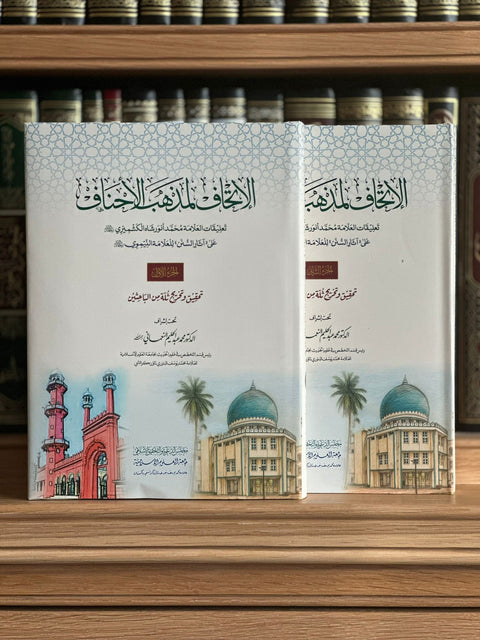
al-Itḥāf li Madhhab al-Aḥnāf
I purchased this long-awaited work from Al Kunūz Bookstore about a week ago and received my copy a few days later.
Since then, I have spent some time reading the extensive introductory study as well as selected portions of the main text.
Below are a few reflections and points that particularly stood out to me:
1) This project was completed under the supervision of Mawlānā ʿAbd al-Ḥalīm Chishtī (d. 2020) and involved the efforts of a team of students. The result is a beautifully produced edition: the text has been carefully typeset, the references meticulously traced, and clear evidence of serious scholarly effort is visible throughout. The introduction alone is substantial, just under 200 pages, and includes several valuable components. These comprise a biography of Imām al-Nīmawī (whose name the editors render as Imām al-Nīmiwī), a detailed study of the background and contents of his celebrated Āthār al-Sunan along with an analysis of his own footnotes, followed by a biography of ʿAllāmah Anwar Shāh Kashmīrī and a study of the background and significance of his annotations on Āthār al-Sunan. The introduction is rich with beneficial insights and serves as a valuable study in its own right.
2) The original handwritten work of ʿAllāmah Anwar Shāh Kashmīrī has been available for a number of years and has even been published in facsimile form. However, due to the difficulty of reading his handwriting, access to its contents has remained limited, and only a small number of readers were able to benefit from it meaningfully. This new edition, therefore, represents a significant step forward in making this important material accessible to a wider scholarly audience.
3) Over the past century, numerous scholars have called for the publication of this work in a properly edited form with its references fully traced and verified. For a long time, expectations were placed on Mawlānā Yūsuf Banorī to undertake this task. He did in fact begin the project, though it ultimately remained incomplete. Nevertheless, one does find citations from al-Itḥāf scattered throughout his Maʿārif al-Sunan, indicating both his engagement with the work and its scholarly value.
4) The introduction also addresses a minor scholarly dispute concerning whether ʿAllāmah Anwar Shāh Kashmīrī assisted Imām al-Nīmawī in the composition of Āthār al-Sunan. This claim is rejected by Imām al-Nīmawī’s son, who argues that Kashmīrī was too young at the time, approximately twenty years old when Āthār al-Sunan was completed, to have contributed meaningfully. As the introduction clarifies, however, the work was being sent to Shaykh al-Hind Maḥmūd Ḥasan, who in turn suggested that it be forwarded to ʿAllāmah Kashmīrī. Kashmīrī then provided a number of juristic observations and insights, an area that was not the primary focus of Imām al-Nīmawī himself (the information is taken from an article written by Molānā Manẓūr Nu’mānī). In any case, the decisive point is that ʿAllāmah Kashmīrī explicitly states that portions of the work were sent to him and that he returned them with annotations. Given this direct testimony, his young age should not be treated as a serious objection to the reality of his contribution. (full discussion is found from pp. 100-3).
5) The editors provide a comprehensive list of the sources cited by ʿAllāmah Anwar Shāh Kashmīrī, identifying approximately 350 works that he drew upon. This is a remarkable number, especially when one considers the historical context: access to books was far more limited, works often lacked detailed tables of contents, and none of the modern search tools or digital databases that now facilitate navigation and cross-referencing were available. Among these sources are around twenty-five works for which the editors were unable to locate definitive bibliographical information. In many cases, these appear to be marginal notes on well-known texts, though the identity of the authors of those annotations remains unclear. It is quite possible that further research, particularly by consulting editions of these works published during or close to Kashmīrī’s lifetime, may yet allow these sources and their authors to be identified.
6) The book itself consists of ʿAllāmah Anwar Shāh Kashmīrī’s own authored writings, in contrast to works such as Fayḍ al-Bārī and al-ʿArf al-Shadhī, which are transcriptions of his lectures. ‘Allāmah Kashmīrī writes with the assumption that his readers already possess a strong grounding in the relevant disciplines. He often alludes to arguments, introduces ideas without fully unpacking them, and at times overwhelms the reader with dense references. The work is not intended as a systematic commentary on Āthār al-Sunan; rather, ‘Allāmah Kashmīrī interjects discussions and observations where he deems them necessary or beneficial. Consequently, some sections (particularly those on topics he had written extensively about, such as rafʿ al-yadayn and witr) contain detailed and in-depth analysis, while other sections are treated very briefly with only minimal remarks.
7) A point highlighted in the introduction, and one I have noted previously with regard to ʿAllāmah Anwar Shāh Kashmīrī’s other works, is that they are in need of detailed explanatory footnotes to clarify his intended meanings. In Urdu scholarship, a number of such tashīlāt (facilitating notes) already exist, making dense texts far more accessible. A recent example is the annotated edition of some of the letters of Mawlānā Qāsim Nānotawī, published by Ḥujjat al-Islām Academy. Such editorial work greatly enhances a reader’s ability to engage with and benefit from the text. Similar explanatory notes would be highly beneficial for ‘Allāmah Kashmīrī’s own authored works if they are to reach a wider audience. Without them, only advanced students are able to fully unpack and cross-reference his arguments independently.
Overall, this work is a most welcome addition to Islamic scholarship. For readers interested in a rigorous and in-depth engagement with the evidences underpinning fiqh, it will prove especially valuable. May Allah reward the scholars and students who laboured on this project and grant acceptance to their efforts.
Interested in Al-Ittihaf li Madhhab al-Ahnaf?
Explore Al-Ittihaf li Madhhab al-Ahnaf, a significant two-volume work featuring the scholarly annotations and juristic discussions of Allamah Anwar Shah Kashmiri on Athar al-Sunan. View the full book details, specifications and availability at Al Kunuz Books.
by Islamic Book Review Podcast


