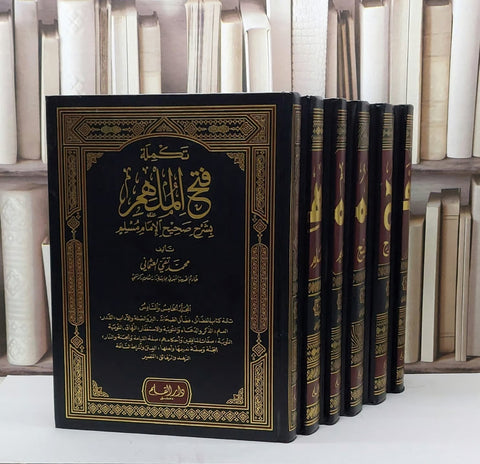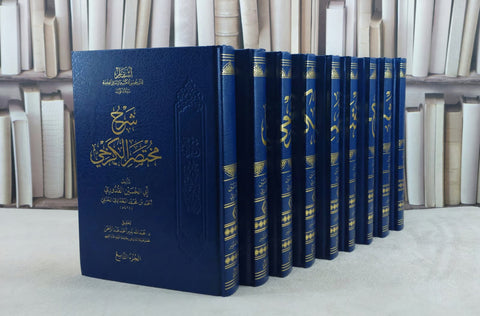
Title : Sharḥ Mukhtaṣar al-Karkhi
Author : Imām Abu 'l-Ḥusayn al-Qudūri (b. 362 AH/973 CE)
Editor : Dr. ῾Abd Allāh Nadhῑr Aḥmad Genre: Ḥanafi fiqh
Publisher : Asfār (Kuwait)
Year of publication : 1443/2022 (1st edition)
Number of volumes : 9
شرح مختصر الكرخي للإمام القدوري ط. أسفار
Published in nine large and beautiful volumes (each volume comprising 650-700 pages) by Asfār (Kuwait), this is the first time this monumental work of a leading and authoritative imam of the ḥanafi legal school (madhhab) is being published. It is the detailed commentary of the short fiqh text (mukhtaṣar) of another yet greater and earlier (by a century) imām of the school.
Imām Abu 'l-Ḥasan al-Karkhi – b. 260 AH (874 CE) – of Iraq and Imām Abu 'l-Ḥusayn al-Qudūri – b. 362 AH (973 CE) – of Baghdad (Iraq) require no introduction to scholars and students of knowledge of the ḥanafi school, and to scholars of the other three schools.
This beautiful edition has been produced using five manuscripts. The researcher-editor, Shaykh Dr. ῾Abd Allāh Nadhῑr Aḥmad of King ῾Abd al-῾Azῑz University (Jeddah), states that he relied mainly on two of these manuscripts and consulted a third when needed. He also sporadically consulted the other two partial and poor-quality manuscripts.
The overall quality of the print, in terms of the paper, binding, design, font etc., is very good. This is reflected in the current price tag of £150 for 9 volumes, here in the UK. On the downside, as with the researcher-editor's recent first ever publication of شرح مختصر الطحاوي (Sharḥ Mukhtaṣar al-Ṭaḥāwi) by Imām al-Isbῑjābi in four large volumes, it is very difficult (practically impossible) for the reader to ascertain where the original text (matn) of the author (Imām Karkhi) begins and ends, and where the commentary of Imām Qudūri begins and ends. He explains in his introduction (p. 10) that the reason for this is that the commentator, Imām Qudūri, per the style of many commentators during that period, has not indicated where the original text of the author is and where his own commentary begins and ends. The result is that the two works – the original text (matn) and the commentary (sharḥ) – have been diluted. This makes the reading experience frustrating, unless you read it as if the entire book is written by Imām Qudūri. Any attempt to demarcate the text from the commentary is further compounded by the fact that the original text of Imām Karkhi, as a separate and independent work, has been lost.
The other shortcoming, in my view, is the overall academic value of the editor's footnotes. They contain mainly brief takhrῑj of the aḥādῑth in the earlier volumes, and a few comments here and there in the later volumes. The researcher-editor excuses himself for doing so, citing the need for brevity and avoidance of unnecessary expansion of the book. Some may like this while others not. My personal preference – and this is something not every student of fiqh may agree with – is to have a moderate level of cross-referencing and explanatory notes (with references), wherever there is a need for this. I also like a moderate level of ḥadῑth takhrῑj in the footnotes, but not dumping everything that one can copy and paste from electronic sources like Maktabah Shāmilah! A moderate level of pointing out differences in the manuscripts used, wherever these occur, is also interesting and beneficial, in my view. Doing so is part and parcel of the preservation of the original academic heritage. This must all be moderate, which, of course, is a relative and subjective term. Having browsed through the volumes, I am conscious that many may feel that this is precisely what the researcher-editor of this current publication has done, and that it is how it ought to be – وللناس في ما يعشقون مذاهب. The researcher-editor's other work – Sharḥ al-Jāmi῾ al-Ṣaghῑr by Imām Qāḍῑkhān – which has been published around the same time (see my comments below) fares worse in this regard. It contains very few footnotes.
In terms of the contents of the book, I must admit that I found it much richer than I had anticipated. Without any doubt, this is one of the most detailed works of the early jurists of the ḥanafi legal school – especially, of the ῾Irāqi branch of the school. Imām Qudūri goes into tremendous depth in expounding each mas̕alah (ruling). He presents the various opinions of the imāms within the ḥanafi school and some who were not adherents to the school,scrutinises, comments and gives preference. Some of these are opinions of imāms, which have not been recorded elsewhere. He also presents the opinions of the imāms of the other three schools of sunni jurisprudence with their evidences and legal theories – especially, the shāfi῾i school, which has historically been the second most dominant school in the world after the ḥanafi school and seen as its main rival in jurisprudence – before strongly critiquing and refuting them with textual evidences from the Qur̕ān and ḥadῑth, and logical/intellectual evidences. The book is rich in this, and, as such, is a treasure trove for scholars and students alike.
Imām Qudūri has added a huge amount of additional topics to what Imām Karkhi has included in his text. Often, where Imām Qudūri feels Imām Karkhi's topics and sub-topics are incomplete or imbalanced, he has pointed this out and added extra material, clearly marked as his own.
In analysing and commentating on each mas̕alah, Imām Qudūri also presents a lot of elucidation from Arabic lexicography (lughah) and Qur̕ānic exegesis (tafsῑr), making his own comments as he does so.
Overall, this is an excellent publication, marking another milestone in the growing field of preservation of ḥanafi academic heritage specifically, and Islamic heritage generally. The money spent on the book will be very well invested, in-shā̕Allāh. Considering the very lofty status of the author (Imām Karkhi) and the commentator (Imām Qudūri) within and beyond the ḥanafi legal school, the early period that they were both from, and the comprehensiveness, depth, overall richness and encyclopaedic nature of this work, one may draw similarities and a parallel with the first ever publication of the eight-volume Sharḥ Mukhtaṣar al-Ṭaḥāwi in 1431 AH (2010 CE) – the author being the magnificent imām of the ḥanafi school, Imām Abu Ja῾far al-Ṭaḥāwi (d. 321 AH/933 CE), and the commentator, Imām Abu Bakr al-Jaṣṣāṣ al-Rāzi (d. 370 AH/981 CE).
Abu Asim Badrul Islam
Northampton, ENGLAND
12 Dhu 'l-Qa῾dah 1443/12 June 2022